
Note: Risk-Averse suggestions are only available with the Lithium ML algorithm, not Helium or older algorithms.
Suggestion types
1. Optimized Suggestions
Default suggested: 5 experimentsOptimized suggestions are designed to drive toward your system's optimal region as quickly as possible. A slight degree of exploration is built into these experiments, which means they balance exploitation of what the model already knows with just enough exploration to avoid getting stuck in local optima.
Collecting data for these suggested experiments will help your model converge on optimized conditions for your outputs with the fewest iterations needed.
|
Primary Goal
|
Model impact
|
|
Best used when
|
Exploration built in?
|
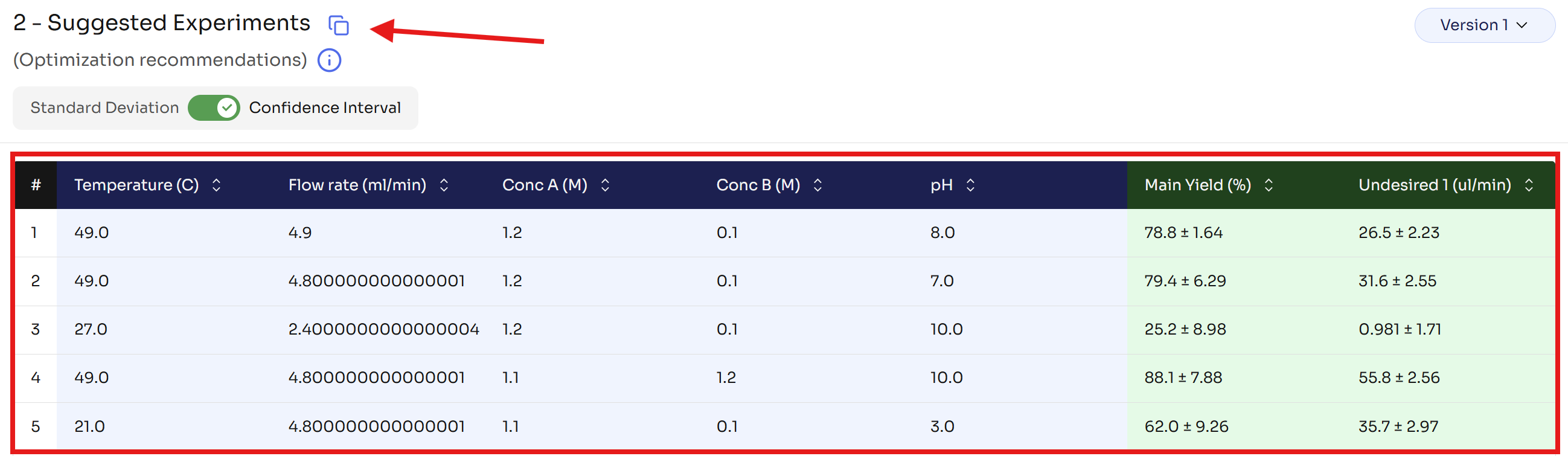
Tip: The optimized suggestions are ranked, so #1 is considered a better recommendation than #2, etc.
If experimental runs are limited, prioritize the top suggested experiments first as these will be most beneficial for the model's active learning in your next iteration.
2. Exploratory Suggestions
|
Primary Goal
|
Model impact
|
|
Best used when
|
Exploration built in?
|

3. Risk-Averse Suggestions
Tip: In order to do Risk-Averse Optimization, the campaign requires at least 1 numerical input.
Risk-averse suggestions target regions of the input space where the predicted output is stable across nearby conditions. Rather than chasing the absolute peak of model performance, these experiments avoid "edges" — areas where a small change in inputs could cause a large, unexpected drop in output performance. The result is robust, reproducible conditions that mitigate the risk of performance drop-offs in practice.
|
Primary Goal
|
Model impact
|
|
Best used when
|
Requirement
|
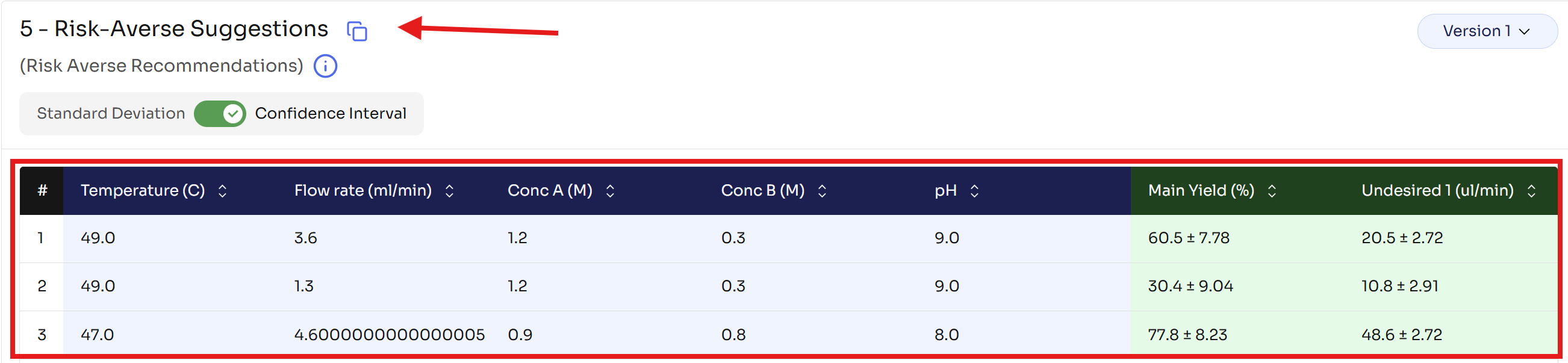
Tip: In most campaigns, running all five optimized suggestions each iteration is the fastest path to convergence. Add exploratory experiments when model uncertainty remains high after multiple iterations, and consider risk-averse suggestions when process robustness is a priority — for example, when conditions will be transferred to manufacturing or repeated across sites.
At a glance
| SUGGESTION TYPE | WHAT IT TARGETS | METRIC IT IMPROVES | WHEN TO PRIORITIZE |
|
1. Optimized |
Predicted optimal region of output space | Output performance; convergence speed | Most iterations — especially early-to-mid campaign |
| 2. Exploratory | Under-sampled regions of input space | Model uncertainty; error metrics | When uncertainty is high or coverage is sparse |
| 3. Risk-Averse | Stable, low-sensitivity regions of input space | Robustness; reproducibility | When transferring to scale-up or requiring consistency |